
Five Questions for Spartak Khachanov about the Exhibition The Impersonal
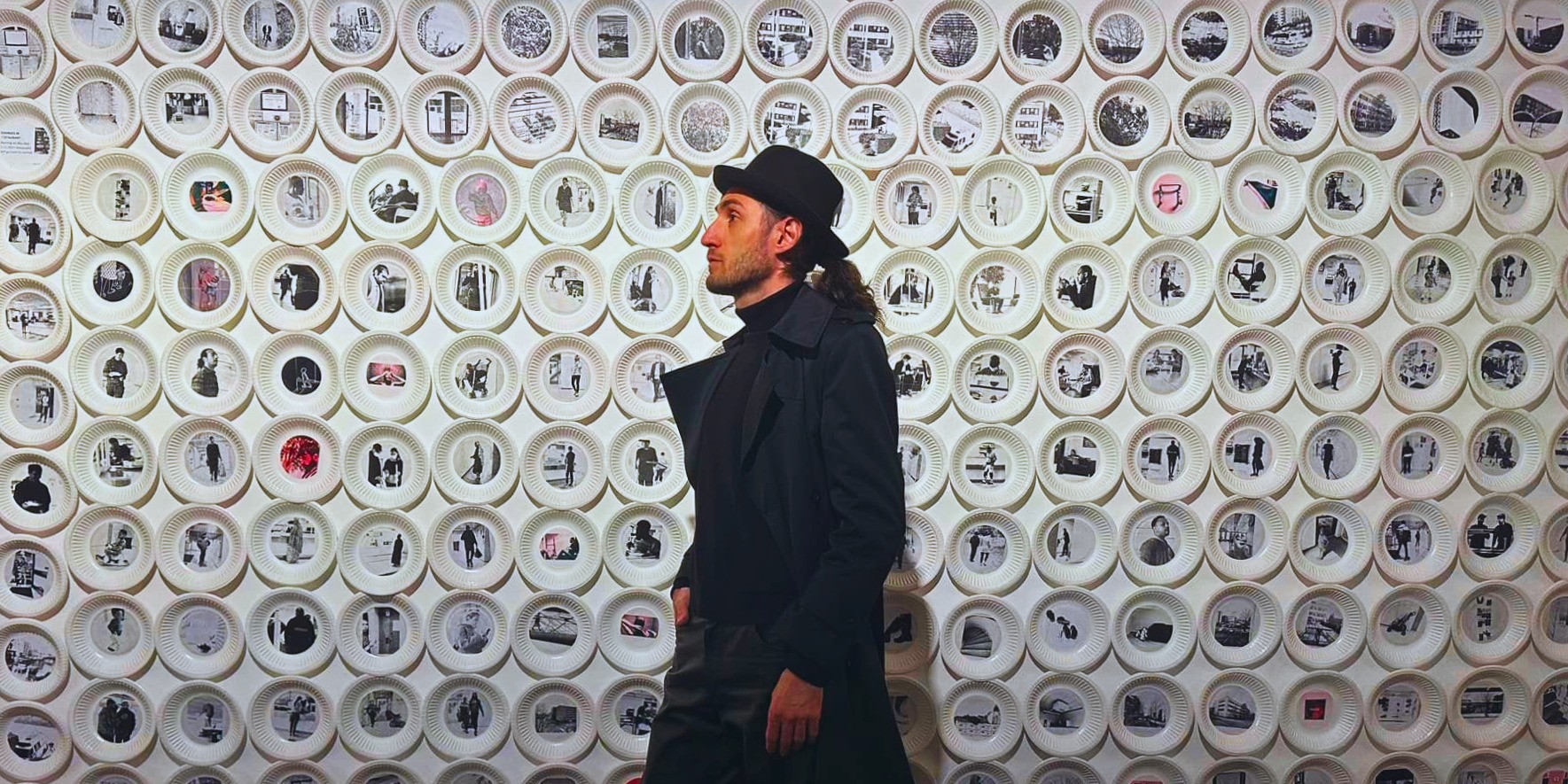
Artist Spartak Khachanovs exhibition The Impersonal is opening this week at the Hotel and Restaurant Museum. The exhibition examines life in reception centres, waiting, and invisibility. We met the Finland-based artist at the Cable Factory in the middle of installing his exhibition, and asked him five questions about the background of the exhibition, its societal context, and his artistic practice.
1. How did your project The Impersonal begin?
At the beginning of 2019, I was forced to leave Ukraine due to threats and persecution by far-right groups. The reason was my art project Parade of Penises. After the exhibition, pressure escalated quickly: first, conflicts arose within the art academy, then I began receiving threats from nationalist organizations. The situation became dangerous, and I had to leave the country urgently. I moved to Finland, where I received a temporary artist residency from HIAP in Helsinki.
I lived and worked in the residency for nearly a year. At the beginning of 2020, however, the residency ended. My wife and I had very little money left, our Schengen visas were expiring, and we could no longer return to Ukraine. We applied for political asylum and ended up living in a reception centre.
The first months were very difficult. After an active life, you suddenly find yourself in a place where time feels almost frozen. Every day is the same. People are constantly waiting: for interviews, documents, decisions, and phone calls. Many live in a state of constant uncertainty and anxiety. In a reception centre, the sense of normal life and control over one’s future gradually begins to disappear.
During that time, HIAP continued to support me and offered me a workspace in their office for several months, which was psychologically very important. I don’t know what would have happened to me without the opportunity to continue working.
It was during this period that The Impersonal began to take shape. At first, I did not think of it as a large artistic research project. It was simply a way to keep myself active and distract my thoughts from the difficult reality around me.
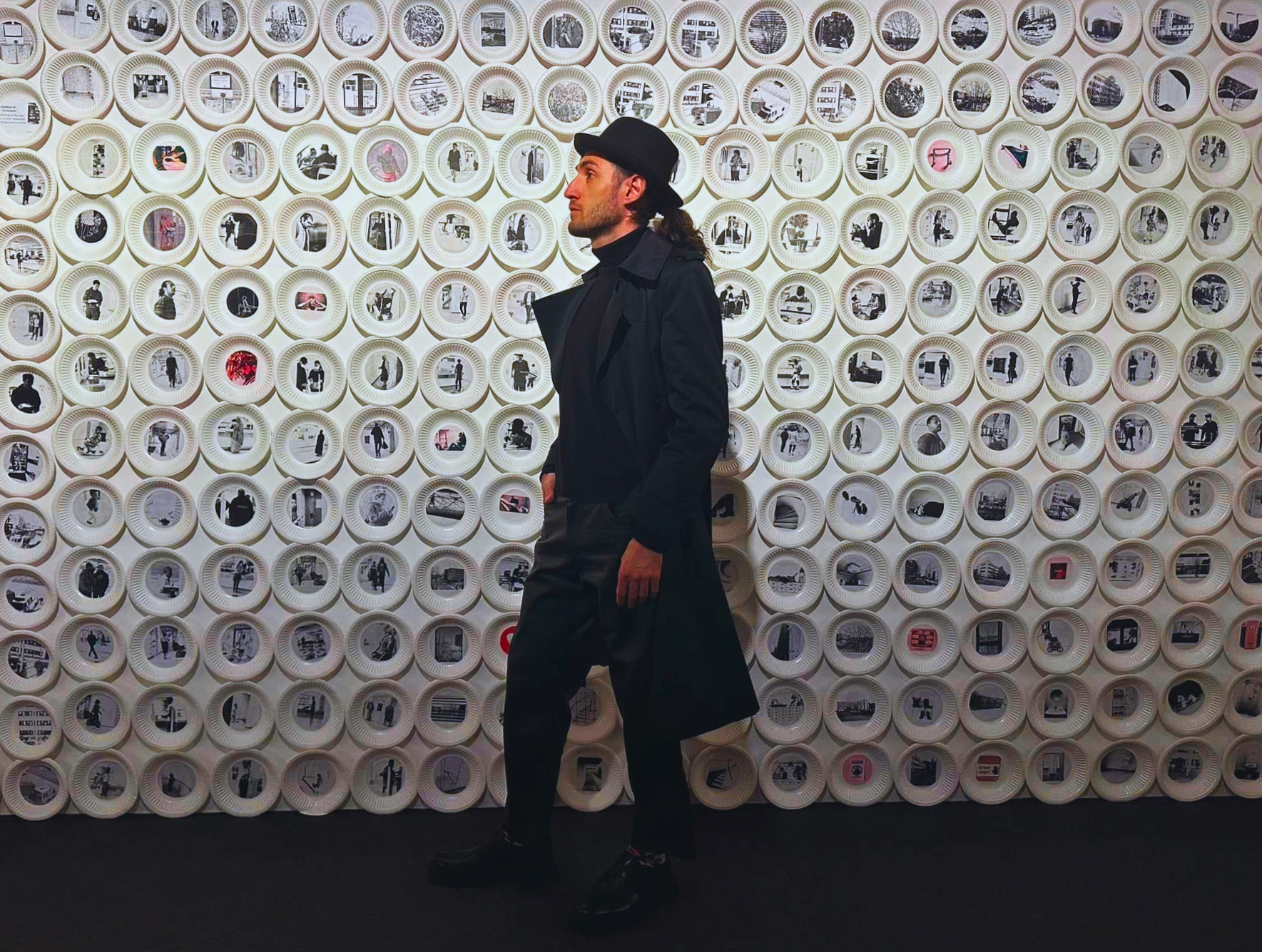
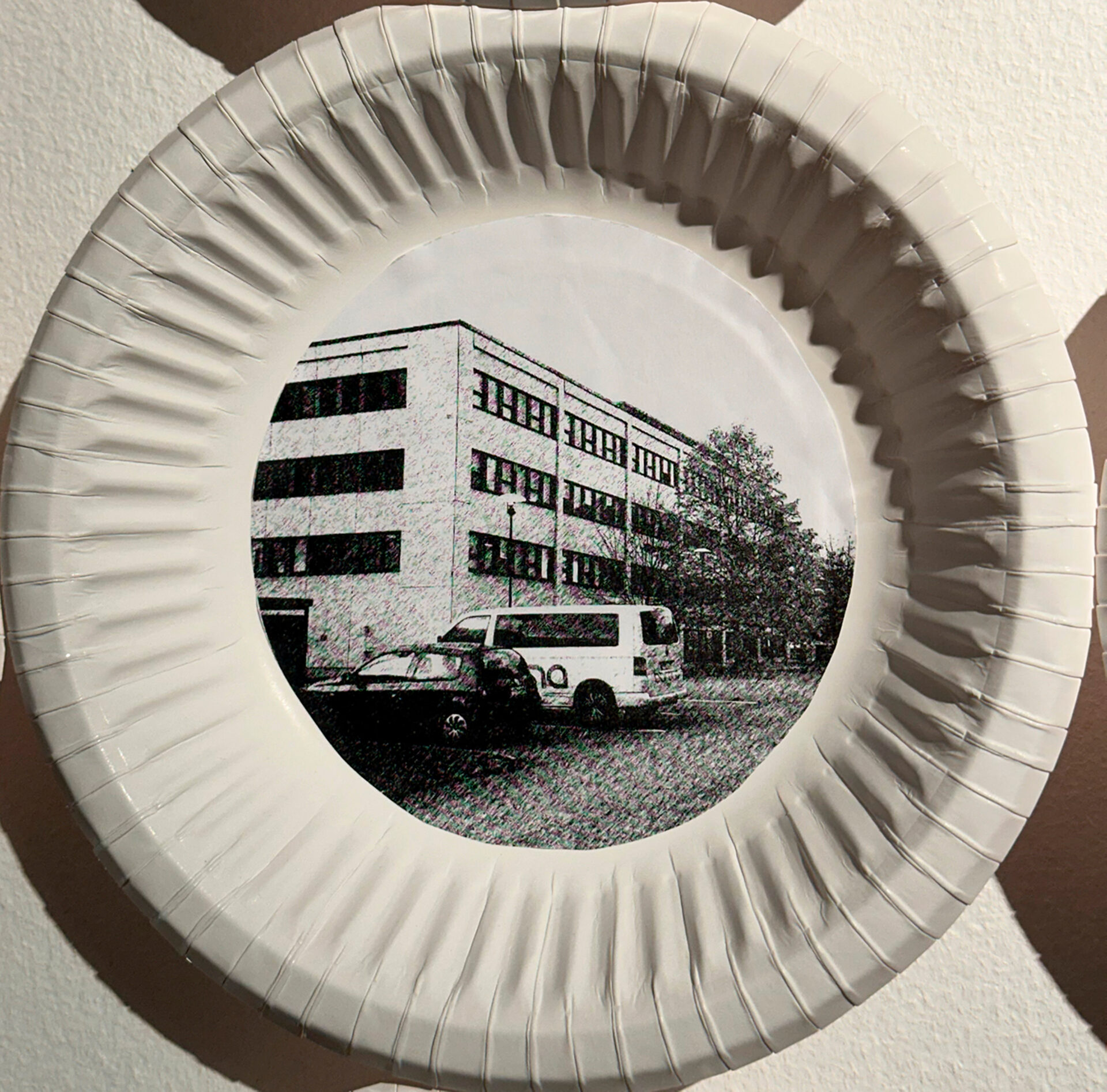
Gradually, I began to pay more attention to the space of the reception centre. I became interested in how this environment functions, how people live in it, and what its rooms, corridors, dining halls, yards, and temporary living conditions are like. I started documenting everyday life around me with my iPhone 7, often discreetly, to capture natural situations without posing or preparation.
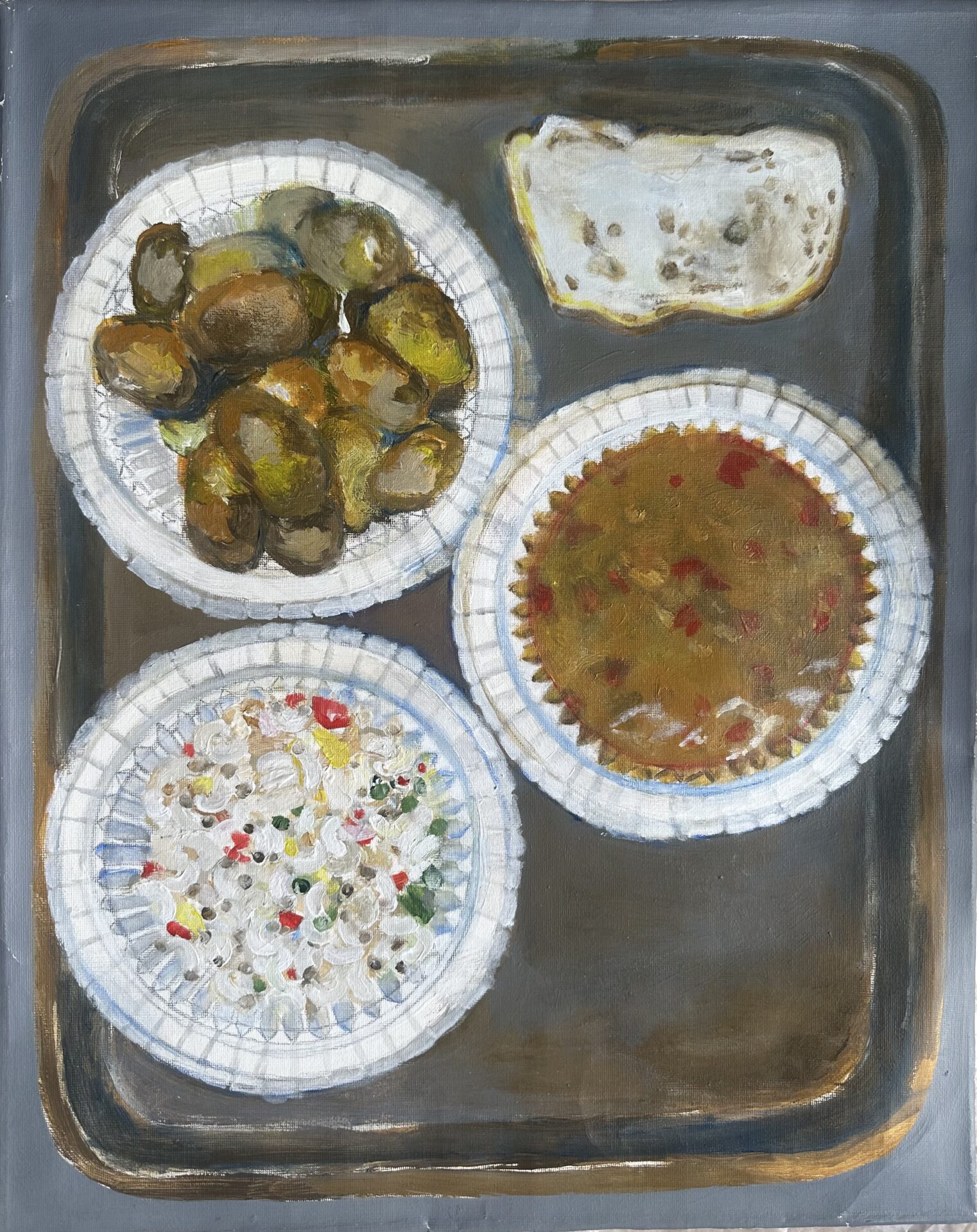
Later, I began incorporating these photos into artworks and installations—for example, attaching images to paper plates. I also created a series of works inspired by the food served in the reception centre, painting daily meals. Through these simple elements, I aimed to depict monotony, waiting, and the experience of living within a system.
Over time, my own experience deepened. I began to feel that I was not just a refugee, but someone studying this space from within and trying to understand its effects on people.
During two years in the reception centre, I collected a large archive of photographs, videos, audio recordings, and observations. My focus shifted not only to refugees but also to the reception centre as a system—one that remains almost invisible in society. Many people in Finland have never been to such a place and know almost nothing about it.
In October 2021, I applied for a grant from the Finnish Cultural Foundation. I was sure I had little chance of receiving it, but at the end of December, I opened my email early one morning and saw that the project had been funded. It was a very significant moment for me. For the first time in a long while, I felt that my experience and work could matter—not just as a personal story, but as an artistic statement.
2. What aspects of everyday life in reception centres did you want to document?
My goal was to create a kind of portrait of a reception centre and to identify its visual and social identity. I was interested not only in how the place looks physically but also in the atmosphere it creates and how it affects people.
I approached the project both as an artist and as a designer with a background in advertising. I saw the reception centre as a visual system with its own signs, colors, objects, recurring elements, and aesthetics—almost like a brand with its own psychology and visual language.
At the same time, I used conceptual approaches and elements of satire, irony, and humor. Humor was essential, because without it, it would be impossible to endure the constant uncertainty and waiting. Sometimes the absurdity of daily life there became artistic material in itself.
I focused on simple but essential aspects: food, queues, rooms, corridors, notices on walls, messages on doors, objects people leave behind, conversations in shared kitchens, walking outside, waiting for buses, and snow in the yard. These details gradually formed a visual portrait of a place where people live between past and future.
3. You have described the reception centre as a kind of “in-between space” where time can lose its meaning and days begin to repeat themselves. How does such an experience affect a person’s relationship to everyday life, their surroundings, and other people?
A person who ends up in such a situation gradually becomes distanced from ordinary social life and loses many of the privileges that we tend to take for granted in our daily existence. People living in reception centres often find themselves in a marginal position—not only legally or economically, but also psychologically. They exist, in a way, alongside society, yet at the same time outside of it.
When a person loses their home, familiar environment, job, language, and social networks, their sense of self and their understanding of the surrounding world begin to change. Life in a reception centre becomes a continuous process of waiting. The future can no longer be planned in the same way as before, many decisions cannot be made independently, and life no longer feels stable. Gradually, the individual loses the sense of control over their own life.
This significantly affects even the most ordinary aspects of daily life. The reception centre becomes a closed world in which each day closely resembles the previous one. Over time, a person begins to experience time, routines, and their environment in a fundamentally different way. Even the smallest actions—standing in a food queue, walking in the yard, or having a conversation in a shared kitchen—gain unusual importance, because these repeating moments come to constitute the entirety of life in the centre.
Relationships between people also change. On the one hand, shared uncertainty and vulnerability can bring people closer together, creating mutual support, solidarity, and a temporary sense of community. On the other hand, constant stress, anxiety, and the lack of personal space may lead to isolation and alienation.
For me, it was important to show that a reception centre is not merely a temporary accommodation facility, but a unique psychological and social environment that has a profound impact on individuals. People living in these places often become invisible to society, even though they exist right in its midst.
4. Food and food culture are an important part of your exhibition. What does food mean to a person in a situation where life is uncertain or suspended in a kind of in-between state?
Food is closely connected to personal memories and forms an essential part of cultural identity. Through food, traditions, history, family habits, and even a sense of home are conveyed. For many people, the taste or smell of a particular dish can instantly evoke memories of childhood, family, or the country they have been forced to leave behind.
As a refugee, food takes on an even deeper meaning. When life feels suspended and the future uncertain, even the most ordinary things become psychologically significant. Food is no longer merely a means of physical survival; it also becomes a way of maintaining a connection to one’s culture, memories, and identity.
Reception centres bring together people from many different countries and cultural backgrounds. Each individual carries with them their own food traditions, ways of preparing meals, attitudes towards eating, and associated rituals. Despite these differences, food often serves as a unifying element. It facilitates trust and human connection, making encounters between people easier. In this sense, food truly has the power to break down boundaries and barriers.
At the same time, the food provided in reception centres is often experienced as bland and impersonal. It lacks individuality, the emotional color of memory, and any meaningful connection to culture or personal experience. It is standardized and repetitive, served day after day, without anything that could be associated with home or history. What remains is only its functional role of sustaining the body.
This sense of impersonality is an essential part of the experience of living in a reception centre. Monotonous meals, strict schedules, and the absence of choice constantly remind individuals that they have lost a degree of control over their lives. At the same time, they reinforce feelings of temporariness and disconnection.
In my artistic work, I approached this system through satire as well. I deliberately presented the food as a kind of “menu,” almost like fast food, where it appears as if there are options and choices available. This illusion of choice highlights the contrast between reality and the way the system can be visually represented or simplified.
I began drawing the meals served in the reception centre because I saw them not only as everyday objects, but also as a psychological portrait of this environment. Through works depicting food, I aimed to convey the experiences of waiting, monotony, and vulnerability that people encounter in such places. In this project, food is simultaneously a memory, a link to one’s culture, a means of communication, and a reflection of the system within which a person who has lost their home exists.
5. What would you like people to understand about reception centres and the people living in them through this exhibition?
I would like people to understand that a reception centre is not an abstract administrative space or merely a temporary housing solution, but a complex human environment in which a significant part of people’s lives takes place under conditions of uncertainty.
From the outside, such centres are often perceived through simplified images—either as part of a support system or as statistics. From the inside, however, they consist of concrete daily actions, waiting, routines, fatigue, hopes, and countless individual life stories.
It is important to recognise that the people living there are not outside society. They are ordinary individuals whose lives have been temporarily put on hold and whose opportunities are limited by external circumstances.
I also want to emphasise that living in such a place affects a person much more deeply than might be visible from the outside. These centres reshape one’s relationship to time, space, oneself, and others. Constant waiting creates a specific psychological condition in which the future becomes uncertain and the past feels out of reach.
Through the exhibition, I hope viewers will see not only the difficulty and vulnerability of this situation, but also the human presence that persists within it: everyday life, efforts to adapt, interactions, humor, and different strategies for coping.
And perhaps most importantly, I hope people will understand that those living in reception centres are not “others.” They are ordinary people who have found themselves in extraordinary circumstances and are trying to rebuild their lives.