
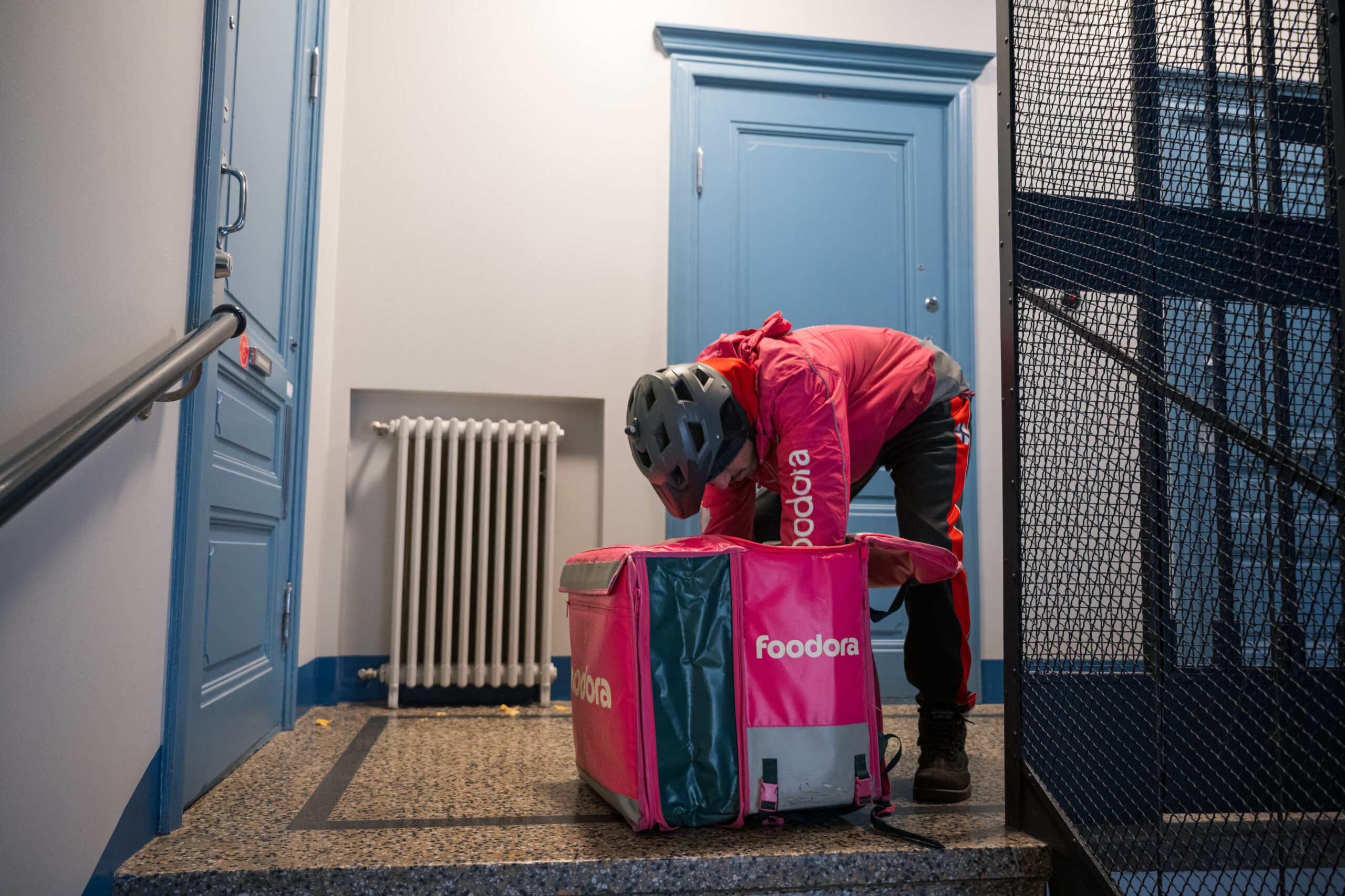
On the Go with a Food Courier
The Hotel and Restaurant Museum’s food courier documentation delved into the food delivery phenomenon that is currently changing the restaurant industry and working life. In the documentation and the accompanying exhibition, Diary of a Food Courier, the food couriers themselves were given a voice. This blog text takes a look behind the scenes of the food courier documentation. Why is it important to record the work of food couriers in the museum’s collection? How was the documentation carried out? What did the food couriers themselves want to tell future generations?
Why food couriers?
Food couriers represent the transformation of working life in the 2020s. The platform economy has blurred the relationship between employees and employers. Many food couriers work as independent contractors. This new way of working has raised questions about who is responsible for things like work safety and social security. The question of the status of food couriers is particularly relevant right now, as the Supreme Administrative Court of Finland ruled in May that food couriers are employees and not entrepreneurs, but that the Working Time Act does not apply to them. Although food couriers are now entitled to employee benefits, almost all couriers still need to have a business ID (Y-tunnus) which emphasizes their status as entrepreneurs. At the beginning of October 2025, Wolt announced it will hire about a hundred couriers as employees. With thousands of people working as couriers, the future of food courier work still remains unclear.

This phenomenon particularly affects immigrants. According to Wolt, around two-thirds of food couriers working in the Nordic countries are immigrants. According to Pellervo economic research PTT, immigrant entrepreneurs’ share of all businesses is the largest in the postal and courier sectors, which include for example food couriers. The share of immigrant entrepreneurs in the courier sector has grown significantly between 2013 and 2021. The Finnish Immigration Service has granted approximately 300 residence permits for entrepreneurs based on courier work each year. Following the Supreme Administrative Court’s decision, food courier work alone is no longer sufficient to obtain a residence permit for entrepreneurs.
The platform economy has transformed the restaurant industry. Deliveries are vital for many restaurants, but Wolt and Foodora’s commission fees have changed the profit margin on food portions. The physical location of a restaurant has become less important: a restaurant may even be just a cloud kitchen without any physical seating. The platform economy has also affected consumers’ attitudes towards restaurant food and dining out. Ordering food to your home has become commonplace. On the other hand, many consumers have begun to question the status and working conditions of food couriers.
The work done by food couriers is a visible part of a broader phenomenon. The discussion about food couriers is not limited to the couriers themselves, but also covers topics such as immigration, entrepreneurship, and employee rights. As a museum of food and drink culture, the Hotel and Restaurant Museum has the expertise to document this multifaceted topic, which is currently shaping both working life and the restaurant industry.

Recording the work of food couriers
Documenting present-day phenomena (nykydokumentointi in Finnish) means recording current phenomena for future generations by taking photographs, conducting interviews, and collecting objects. At its best, documentation involves the target community and highlights the perspectives of subcultures and minorities. The aim of the food courier documentation was to record the couriers’ everyday work and bring to the forefront their voices which are often unheard in the social debate.
The documentation and the small exhibition based on the documentation, Diary of a Courier, were carried out in collaboration with the Service Union United PAM and the courier organization PAM Couriers Finland ry. Reaching couriers through the museum’s traditional communication channels proved challenging, but cooperation with PAM Couriers Finland ry helped establish contacts with them. In addition, the museum distributed flyers to couriers on the streets to ensure that information about the documentation reached as many members of the food courier community as possible.
The recording was carried out during the fall of 2024 and spring of 2025. Photographer Yehia Eweis photographed three food couriers at work. The museum recorded the visibility of couriers on the streets more broadly by photographing and observing their work. An online survey was used to collect the couriers’ experiences of their work. The museum interviewed three couriers. Wolt and Foodora donated the couriers’ work equipment to the museum. All the material collected during the documentation process was stored in the collections of the Hotel and Restaurant Museum.

Close cooperation with the courier community ensured that the things and perspectives that the couriers considered significant in their work were documented. The couriers also participated in making decisions about the practical details of the documentation. The photographer and the couriers being photographed decided on the content and timing of the photo sessions. The couriers who were photographed participated in selecting the photos for the exhibition. Some of the survey respondents wished to remain anonymous, so all quotes in the exhibition were left anonymous. The couriers could answer the survey in a way that suited them, and they could attach images, videos, or audio recordings. The documentation was carried out in English. An appropriate fee for participating in the photo sessions and interviews was agreed upon with PAM Couriers Finland. Food couriers can visit the Diary of a Courier exhibition free of charge.
From the perspective of couriers
In the food courier documentation, the everyday life of food couriers in the mid-2020s was recorded in the Hotel and Restaurant Museum’s collections. In the photographs, food couriers rush through the streets of Helsinki in late autumn, picking up orders and delivering food to customers. Interviews and survey responses highlighted the everyday aspects of delivery work, such as the challenges posed by the weather. The couriers discussed their relationships with the platforms, restaurants, customers, and other couriers. Their relationships with customers and restaurants were generally perceived as positive. The flexibility of the work was seen as a positive aspect of courier work, as it made it possible to combine multiple jobs, entrepreneurship, studying, or family life. The opportunity for independent work and self-management was seen as a positive aspect. Negative aspects mentioned included low-income levels, dissatisfaction with platforms, competition for shifts, and the uncertain future of the platform economy.
The interviews and survey responses highlighted the perspectives that make the food courier phenomenon so topical and important to document. The Supreme Administrative Court’s May decision was seen by the interviewees as a step forward but insufficient in itself to guarantee the employee rights of food couriers. The platform economy was even seen as the only opportunity for immigrants who do not speak Finnish to find employment. Relationships with the platforms were complex. The positive aspects of courier work and the employment opportunities it offered were not enough to compensate for the decreased income level and the platforms’ lack of commitment to ensuring sufficient working hours, occupational safety, and social security.
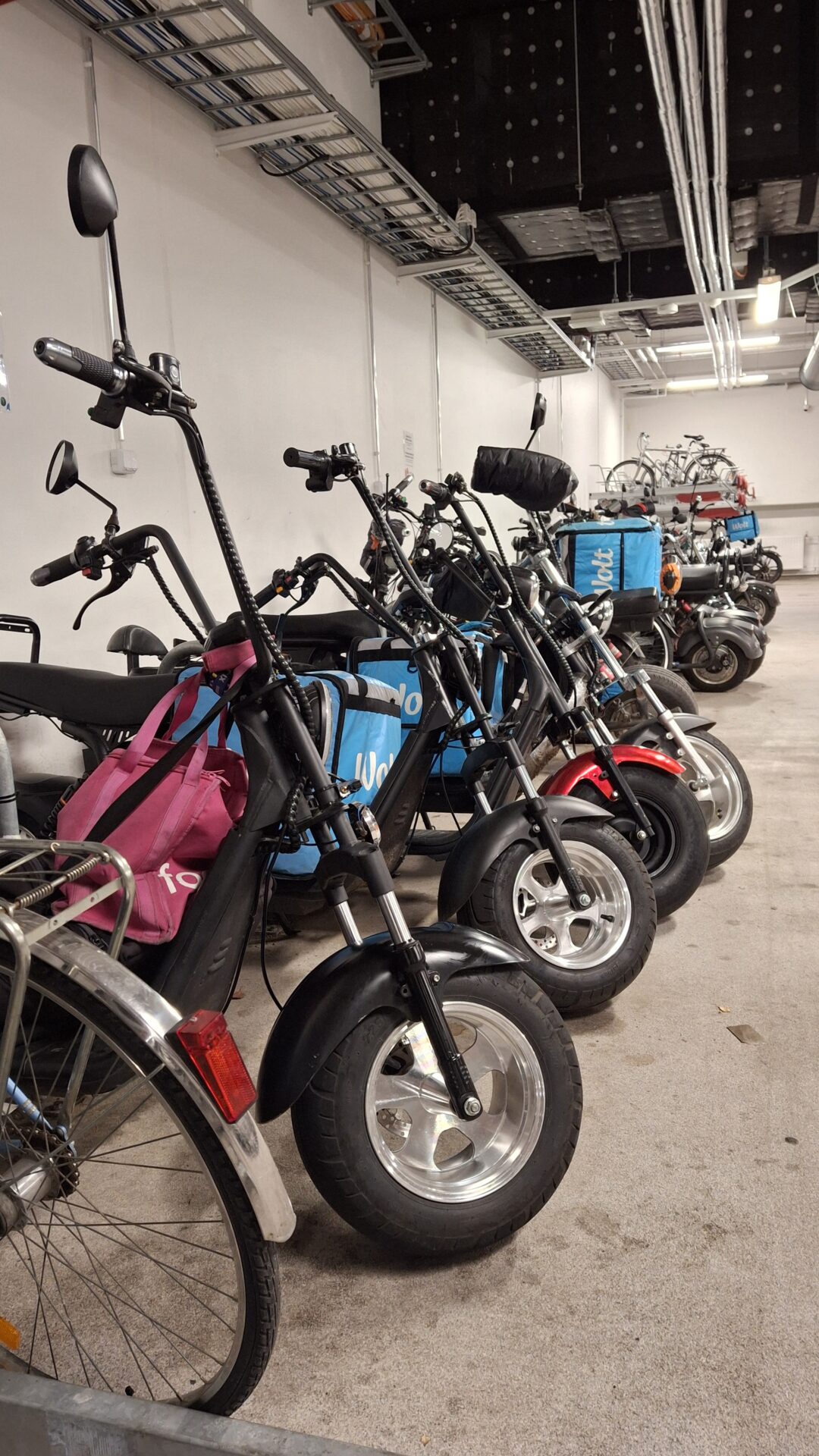
One of the interview questions asked the food couriers what they themselves would like to preserve from their work in museum collections and record for future generations. The answers varied. One respondent hoped the documentation of food delivery in different seasons, as the weather changes the nature of the work. Another respondent speculated on the future of the industry, noting that the work is an excellent example of flexibility and independence, but with wages falling, the compensation for delivery work is no longer enough to live on. In his opinion, courier work cannot continue for long in Finland. A third respondent saw food couriers as bringing restaurants into people’s homes – a great concept that he hopes will continue in a sustainable way in the future.
Although there is heated public debate about the food courier phenomenon, the interviews and survey responses from food couriers revealed that they felt their voices were not being heard sufficiently in this debate. The fact that the museum took part in the public debate and specifically documented the couriers’ perspective was considered significant among the couriers. In one survey response, the respondent thanked the museum for its documentation work: “Thank you for taking time to take down our stories and our view. Although it is a crucial part of the restaurant business and it makes sense for you to do this, it has also been a positive reminder that someone cares to listen.”
Diary of a Food Courier mini exhibition is on display at the Hotel and Restaurant Museum 7.10.2025–17.5.2026.
Sources:
27. kysymystä ja vastausta Woltista ja lähteistä. Wolt Blog 11.1.2019 https://blog.wolt.com/fin/2019/11/01/27-kysymysta-ja-vastausta-woltista-ja-laheteista/ Visited 3.9.2025.
296. Maahanmuutajien merkitys yritys- ja elinkeinotoiminnassa. PTT Raportteja 2025. https://www.ptt.fi/julkaisut/maahanmuuttajien-merkitys-yritys-ja-elinkeinotoiminnassa/ Visited 3.9.2025.
Parviala, Antti. Wolt taipui: alkaa palkata lähettejä työntekijöiksi – palkka keskimäärin 14 euroa tunnissa, yrittäjille 21 euroa https://yle.fi/a/74-20186937 Visited 13.10.2025.
Passoja, Annu. Tuore Wolt-päätös voi tuoda kymmenille ruokaläheteille karkotusuhan – rovaniemeläinen tekoälyinsinööri on yksi heistä Yle Uutiset 17.6.2025 https://yle.fi/a/74-20168006 Visited 3.9.2025.
STT, Frilander, Jenni, Toivonen, Janne. KHO: Ruokalähetit ovat työntekijöitä, eivät itsenäisiä yrittäjiä – yhtiöt ovat ”aika ison remontin” edessä, sanoo professori Yle Uutiset 22.5.2025 https://yle.fi/a/74-20163392 Visited 3.9.2025.
The original article was published in Finnish. This English translation was written with the help of DeepL.com.